PM Tools
VM
SecOps
Active Directory Integration for Patch Management and Vulnerability Remediation

Ashwani Paliwal
April 21, 2026
Most enterprise environments already have a well-defined structure.
Users, devices, departments, and access controls are organized inside Active Directory. This structure reflects how the business actually operates.
But when it comes to patch management and vulnerability remediation, that structure is often ignored.
Teams are forced into disconnected workflows where assets are rediscovered, groups are recreated, and context is rebuilt manually.
This is where operational time gets lost.
In many organizations, patching and vulnerability management tools operate independently of Active Directory.
This leads to common challenges:
The result is a gap between how environments are structured and how remediation is executed.
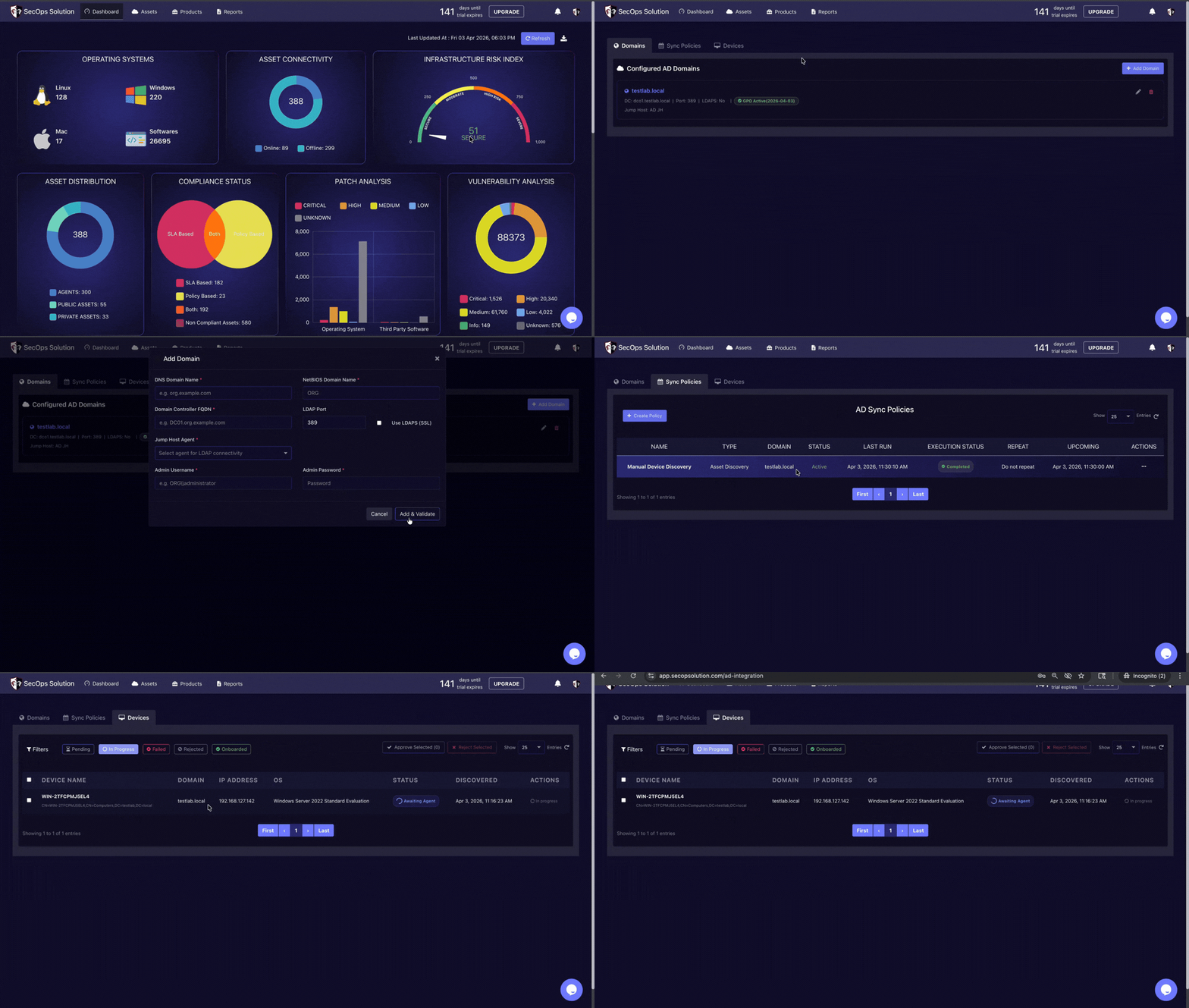
Active Directory integration in SecOps Solution allows organizations to directly connect their domain and sync their existing environment into the platform.
Instead of rebuilding asset structures, SecOps uses what already exists in Active Directory.
This enables:
With direct Active Directory integration, all existing structures can be imported into SecOps Solution.
This reduces setup time and eliminates redundant effort.
One of the biggest limitations of traditional agentless patching tools is their dependency on static IP addresses.
In modern enterprise environments, especially with laptops and remote systems, IP addresses change frequently.
SecOps Solution uses FQDN and domain-based identification instead of relying only on IP addresses.
This allows:
Once Active Directory is integrated:
This ensures that growing environments remain consistently managed without increasing operational overhead.
Instead of defining policies manually, teams can use existing AD groups to drive:
This ensures consistency across IT and security operations while reducing manual configuration.
Consider an enterprise with multiple departments such as Finance, Engineering, and IT.
In a typical setup:
This leads to duplication and frequent inconsistencies.
With Active Directory integration in SecOps Solution:
For example:
No manual regrouping. No missed systems. No policy drift.
Agentless patch management is often limited in real-world environments due to:
By integrating with Active Directory, SecOps Solution removes these limitations.
This makes agentless patching viable across:
With Active Directory integration, organizations can:
Most importantly, it eliminates the need to rebuild what already exists.
Active Directory has always been the foundation of enterprise IT environments.
With this integration, it becomes the foundation for patch management and vulnerability remediation as well.
Instead of forcing teams into parallel workflows, SecOps Solution allows security operations to align directly with the existing environment.
If your organization relies on Active Directory, this integration can significantly simplify patch management and vulnerability remediation.
Schedule a demo to see how it fits into your environment: click here
SecOps Solution is an agentless patch and vulnerability management platform that helps organizations quickly remediate security risks across operating systems and third-party applications, both on-prem and remote.
Contact us to learn more.

.jpg)


.jpg)