Compliance
SecOps
Security
Dubai ISR Infrastructure Security Compliance Checklist

Ashwani Paliwal
April 6, 2026

The ISR framework is not just a compliance requirement it serves as a strategic foundation for building resilient, secure, and well-governed IT environments. It defines clear expectations around infrastructure protection, risk management, access control, monitoring, and incident response, ensuring organizations can defend against modern cyber threats effectively.
In this blog, we explore how organizations can implement an ISR-aligned infrastructure security framework and operationalize these controls efficiently. We also demonstrate how leveraging an automated and centralized approach can simplify compliance while strengthening overall security posture.
This architecture illustrates how organizations can operationalize infrastructure security controls aligned with the Dubai Electronic Security Center Information Security Regulation (ISR) using the SecOps Solution platform.
The bottom layer represents the organization’s infrastructure where ISR security controls must be implemented.
Typical infrastructure includes:
- Servers
- Endpoints
- Cloud workloads
- Virtual machines
- Application infrastructure
- Remote employee devices
These assets represent the systems that must remain compliant with ISR security requirements.
Security teams must continuously assess infrastructure for risks including:
1. Vulnerabilities in operating systems
2. Unpatched third-party software
3. Misconfigured systems
4. Outdated software versions
This layer involves vulnerability discovery and security posture visibility across infrastructure.
The SecOps Solution platform sits in this layer and provides operational security capabilities including:
1. Vulnerability management
2. Automated patch management
3. Configuration auditing
4. Infrastructure asset visibility
The platform enables security teams to move from vulnerability identification to automated remediation workflows.
Security teams can perform:
1. Automated patch deployment
2. Remediation of identified vulnerabilities
3. Configuration hardening
4. Software update management
This reduces the risk exposure window and ensures security issues are addressed quickly.
The top layer supports regulatory compliance and security oversight.
Capabilities include:
1. Security dashboards
2. Remediation tracking
3. Compliance evidence generation
4. Audit reporting
This helps organizations demonstrate alignment with ISR security expectations during audits or regulatory reviews.
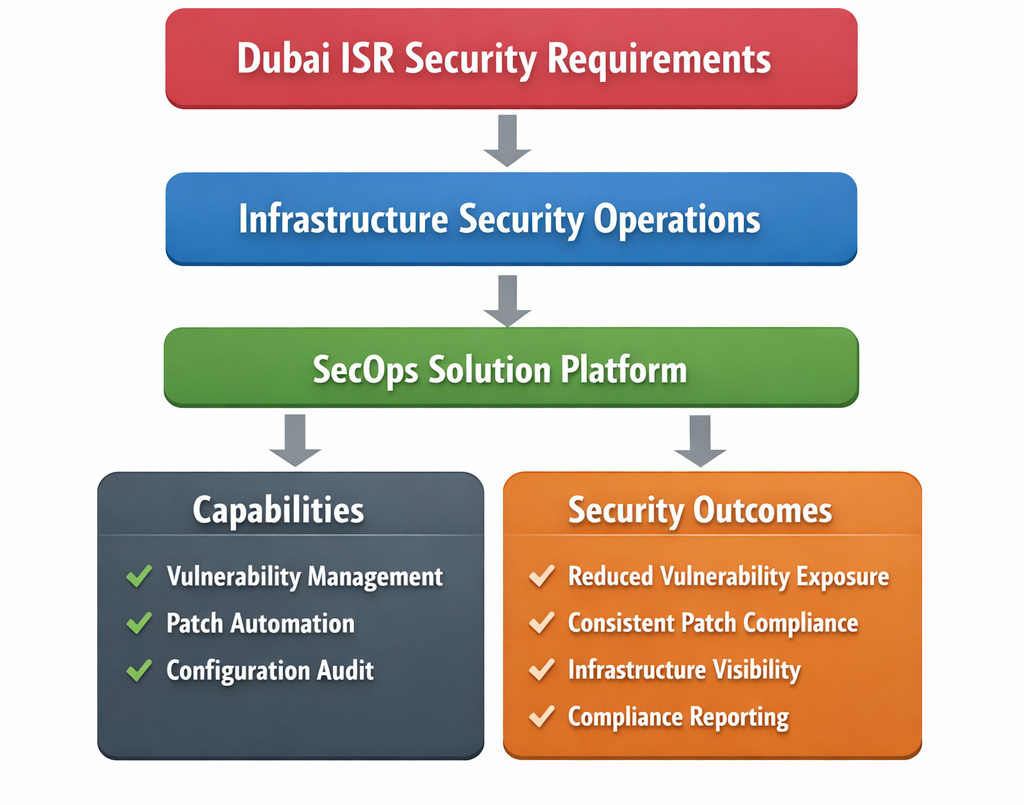
Organizations operating within the Dubai government ecosystem must implement cybersecurity practices aligned with the Dubai Electronic Security Center Information Security Regulation (ISR).
The checklist below helps organizations evaluate their readiness across key infrastructure security domains.
Do you maintain a centralized inventory of all IT assets including servers, endpoints, and cloud workloads?
Are asset owners and system roles clearly defined?
Can your security team quickly identify which systems are exposed to vulnerabilities?
Do you maintain visibility into software installed across infrastructure?
Are vulnerability assessments conducted regularly across infrastructure?
Can your security team prioritize vulnerabilities based on risk severity?
Do you track remediation progress for identified vulnerabilities?
Is vulnerability remediation tracked across both operating systems and applications?
Are security patches deployed consistently across all systems?
Can your organization deploy patches remotely across infrastructure?
Are third-party applications included in your patch management process?
Can you track patch deployment status across all systems?
Are systems hardened according to recognized security benchmarks?
Can configuration deviations be detected automatically?
Do you regularly review configuration security across infrastructure?
Can vulnerabilities be remediated quickly after discovery?
Do security teams have visibility into patching status across infrastructure?
Are remediation actions tracked and documented for audit purposes?
Can your organization produce reports showing vulnerability remediation status?
Are patching activities logged and tracked?
Can security teams demonstrate compliance during regulatory audits?
The SecOps Solution platform enables organizations to operationalize infrastructure security practices aligned with ISR requirements through:
1. Centralized infrastructure visibility
2. Automated vulnerability remediation
3. Automated operating system and application patching
4. Configuration auditing capabilities
5. Security reporting for compliance and audits
By combining vulnerability management, patch automation, and configuration monitoring into a single platform, organizations can maintain stronger security posture while supporting regulatory compliance initiatives.
SecOps Solution is an agentless patch and vulnerability management platform that helps organizations quickly remediate security risks across operating systems and third-party applications, both on-prem and remote.
Contact us to learn more.

.jpg)

.jpg)