Agentless security for your infrastructure and applications - to build faster, more securely and in a fraction of the operational cost of other solutions

hello@secopsolution.com
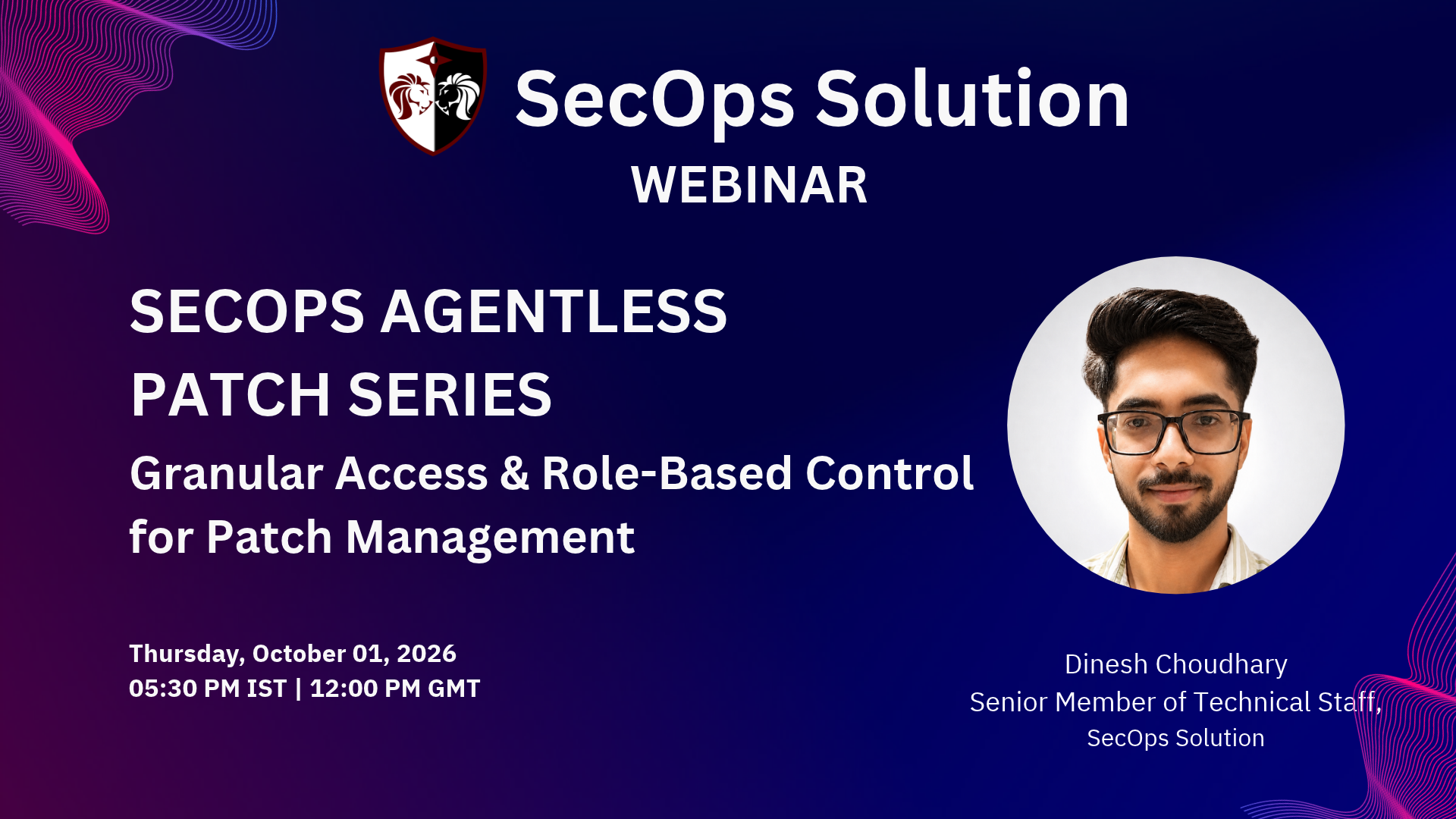
Modern IT environments often span multiple sites, teams, and business units, each with different access requirements and operational responsibilities. Managing patching across these environments requires more than centralized visibility - it requires clear data separation, controlled permissions, and consistent security policies.
In this webinar, we explore how SecOps Solution uses Multi-Tenancy and Role-Based Access Control (RBAC) to simplify access management across distributed patch management environments.
Through a practical product demonstration, learn how to create and manage zones, isolate asset and vulnerability data between sites, invite users, assign predefined or custom roles, and control permissions for individual modules and operations.
The session also demonstrates how organizations can enforce patch approval requirements, apply security settings across multiple zones, protect endpoint agents from unauthorized removal, and maintain user activity logs for operational oversight and compliance.
Whether you manage multiple enterprise sites or support several customers as an MSSP, this webinar explains how to maintain centralized governance while giving each team access only to the resources and operations relevant to its responsibilities.
The session begins with an overview of SecOps Solution's vulnerability and patch management capabilities, followed by a focused walkthrough of Multi-Tenancy and RBAC.
The demonstration shows how administrators can create separate zones for different sites, environments, or operational use cases. Each zone maintains its own asset and dashboard data, helping prevent information from one site from being visible in another.
The webinar then covers user onboarding and role assignment. Administrators can invite users, restrict their access to specific zones, and assign predefined or custom roles with granular permissions across platform modules. These controls help distinguish between users who can view information, modify configurations, manage assets, execute scans, or deploy patches.
A key focus is patch governance. The session demonstrates how patch approval permissions can be assigned to designated users and how approval requirements can be enforced to prevent unauthorized patch deployments. It also explains how organization-level settings can establish mandatory controls across zones, while zone-level settings support local operational requirements.
Finally, the webinar covers user activity logs and reporting, providing visibility into actions performed on the platform and supporting operational accountability and compliance.
SecOps Solution is an award-winning agent-less Full-stack Vulnerability and Patch Management Platform that helps organizations identify, prioritize and remediate security vulnerabilities and misconfigurations in seconds.
To schedule a demo, just pick a slot that is most convenient for you.


.png)


.jpg)
.png)
.png)
.jpeg)