Agent-Based
Agentless
SecOps
Agentless vs Agent-Based Patching: Which Approach Is Better for Modern IT Environments?

Ashwani Paliwal
November 20, 2026


Agent-based patching is a patch management approach that uses a dedicated software component, known as an agent, installed on every endpoint or server that needs to be managed.
The agent communicates with a centralized patch management server or platform. It collects system information, identifies missing patches, receives deployment instructions, downloads updates, and installs them on the endpoint.
Because the agent runs locally on the device, it can perform patch-related activities even when the device is not continuously connected to the central management server, depending on the agent's capabilities and configuration.
The typical agent-based patching process involves the following steps:
1. Agent Installation: IT administrators install a patch management agent on every endpoint, server, or workstation they want to manage.
2. System Inventory: The agent collects information about the operating system, installed applications, software versions, and missing updates.
3. Patch Assessment: The collected information is sent to the centralized patch management platform, where available updates are evaluated.
4. Patch Deployment: Administrators create deployment policies, and the agent receives instructions to download and install the required patches.
5. Installation and Reporting: The agent executes the installation process locally and reports deployment status, success, or failure to the central platform.
1. Continuous Endpoint Monitoring
Agents can periodically collect endpoint information and report changes to the central management platform. This helps IT teams maintain visibility into managed devices.
2. Suitable for Remote Endpoints
Agent-based patching can be useful for remote employees and devices that are not always connected to the corporate network. Agents can operate independently and synchronize with the management platform when connectivity becomes available.
3. Detailed Endpoint Information
Since the agent operates directly on the endpoint, it can collect detailed information about installed software, operating system versions, patch status, and deployment results.
4. Automated Patch Deployment
Agents can automatically download, install, and report patches based on predefined policies, reducing the need for manual intervention.
Despite its advantages, agent-based patching introduces several operational challenges.
For organizations with large IT infrastructures, maintaining the agents themselves can become another responsibility for already occupied IT teams.
Agentless patching is a patch management approach that does not require a permanently installed patch management agent on every endpoint.
Instead, the patch management platform communicates with target systems through available remote management protocols, APIs, or other supported mechanisms to assess their patch status and deploy updates.
Depending on the platform and environment, this communication may use technologies such as SSH, Windows Remote Management (WinRM), Windows Management Instrumentation (WMI), or cloud provider APIs.
Once the required connection and permissions are established, administrators can discover missing patches, initiate deployments, and monitor results from a centralized platform.
Unlike traditional agent-based approaches, agentless patching eliminates the need to install and maintain a dedicated patch management agent on every managed device.
The agentless patching process generally follows these steps:
1. System Discovery: The patch management platform identifies endpoints and servers within the environment.
2. Remote Authentication: It establishes secure communication with the target systems using supported protocols and authorized credentials.
3. Patch Assessment: The platform collects system information and identifies missing security updates and patches.
4. Patch Download and Deployment: Required patches are downloaded and deployed remotely to the target systems.
5. Verification and Reporting: The platform checks deployment results and provides visibility into patch installation status.
1. No Permanent Agent Installation
One of the biggest advantages of agentless patching is that organizations do not need to install a dedicated patch management agent on every endpoint. This reduces deployment and maintenance overhead.
2. Simplified Management
IT administrators can manage patching activities from a centralized platform without having to monitor the health and availability of individual patch management agents.
3. Reduced Endpoint Overhead
Without a permanently running patch management agent, endpoints avoid the additional resource consumption associated with that agent.
4. Faster Onboarding
New systems can be brought under patch management without going through a separate agent installation process, provided the required network connectivity, credentials, and permissions are available.
5. Centralized Visibility
Administrators can assess patch status, initiate deployments, and monitor results from a single management interface.
Agentless patching also comes with certain limitations that organizations should consider.
Therefore, agentless patching is not automatically suitable for every environment. Organizations must evaluate their network architecture, security requirements, and endpoint configurations before choosing an approach.
Both approaches help organizations automate patch deployment and maintain system security. However, they differ in how they communicate with endpoints and manage patching operations.
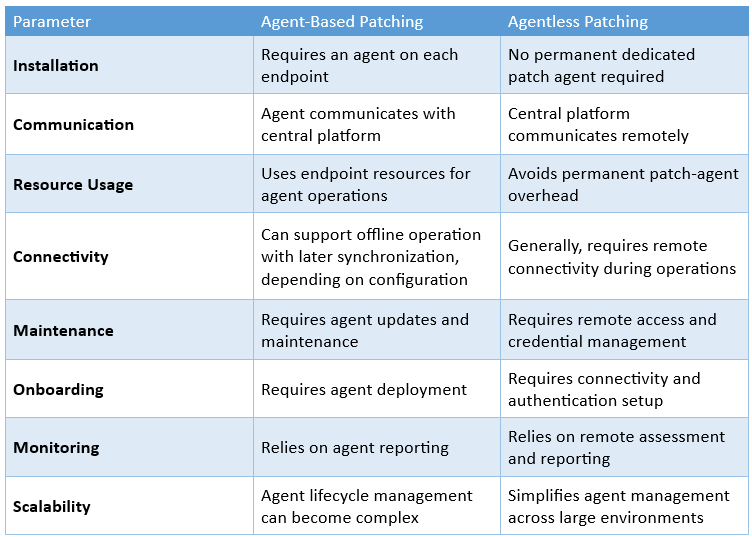
There is no single approach that works best for every organization. The right choice depends on infrastructure size, network architecture, security policies, endpoint distribution, and operational requirements.
Here are some factors to consider.
Organizations managing a large number of endpoints should consider the operational overhead of installing, updating, and maintaining agents.
Agentless patching can simplify onboarding and centralized management, particularly in environments where remote access is already established.
However, agent-based patching may be more suitable when organizations need continuous endpoint-level communication or operate in environments with unreliable connectivity.
Network connectivity plays an important role in determining which approach is practical.
Agentless patching depends on remote communication between the management platform and target systems. Organizations with strict firewall policies or isolated network segments may need additional configuration.
Agent-based patching can offer more flexibility for devices that periodically disconnect from the corporate network, depending on how the agent handles patch downloads and synchronization.
Both approaches require appropriate security controls.
For agentless patching, organizations must securely manage administrative credentials, restrict remote access, and protect communication channels.
For agent-based patching, organizations must ensure agents are securely installed, updated, authenticated, and protected against tampering.
If IT teams spend considerable time troubleshooting agents, maintaining compatibility, and deploying agents across new systems, agentless patching may help reduce operational complexity.
On the other hand, agent-based patching may provide more suitable capabilities for environments that depend on persistent endpoint monitoring.
Organizations should also evaluate the types of patches they need to deploy, supported operating systems, application compatibility, reboot requirements, rollback capabilities, and deployment verification.
The patching approach should support the organization's actual remediation requirements rather than simply focusing on whether an agent is installed.
Every IT environment has different patch management requirements. While some organizations prefer agentless patching to reduce endpoint overhead, others rely on agents for managing endpoints across remote or distributed environments.
SecOps Solution supports both agentless and agent-based patch management, giving organizations the flexibility to choose an approach that aligns with their infrastructure, connectivity, and operational requirements.
Here's how SecOps Solution makes patch management easier:
SecOps Solution allows organizations to manage patches using both agentless and agent-based approaches. This flexibility helps IT teams handle different endpoint environments without being restricted to a single patching model.
Whether endpoints are managed through agents or agentless communication, IT administrators can simplify patch management activities through a centralized platform.
Deploying updates without validation can introduce compatibility issues. SecOps Solution offers pre-validated and revertible patches, helping organizations minimize deployment risks and recover from unexpected patch-related issues.
IT teams can simplify remediation with one-click patch deployment, reducing repetitive manual work and making it easier to manage updates across multiple endpoints.
SecOps Solution supports driver patching and offline patching, helping organizations address specialized patch management requirements and environments with limited internet connectivity.
Organizations managing endpoints across multiple offices and locations need a consistent patching strategy. SecOps Solution helps IT teams coordinate patch deployments and maintain visibility across their infrastructure.
Agentless and agent-based patching both play important roles in modern patch management. While agentless patching reduces the overhead of installing and maintaining dedicated agents, agent-based patching provides another approach for managing endpoints that require local agent capabilities.
Rather than choosing one approach for every situation, organizations should evaluate their infrastructure, connectivity, security requirements, and operational needs.
SecOps Solution supports both agentless and agent-based patch management, giving organizations the flexibility to manage diverse IT environments through a centralized platform. With capabilities such as pre-validated and revertible patches, one-click deployment, driver patching, and offline patching, it helps IT teams simplify remediation and maintain a secure, up-to-date infrastructure.
SecOps Solution is an agent-based and agentless patch and vulnerability management platform that helps organizations quickly remediate security risks across operating systems and third-party applications, both on-prem and remote.
Contact us to learn more.