Vulnerability
Security
SecOps
Vulnerability Remediation SLAs: How to Set Realistic Patch Deadlines Based on Risk

Ashwani Paliwal
October 13, 2026

A vulnerability remediation SLA is a defined timeframe within which an organization is expected to remediate a vulnerability after it has been identified or formally prioritized.
For example, an organization might require critical vulnerabilities on internet-facing production servers to be remediated within 24 hours, while low-risk vulnerabilities on isolated systems may have a 90-day deadline.
A remediation SLA typically defines:
An effective SLA is not simply a compliance requirement. It is an operational framework that helps security and IT teams work toward measurable risk reduction.
Many organizations base remediation deadlines primarily on the Common Vulnerability Scoring System (CVSS). Although CVSS is useful for understanding vulnerability severity, it does not independently establish how likely a vulnerability is to be exploited in a particular environment.
Consider two vulnerabilities with a CVSS score of 9.8:
Treating both vulnerabilities identically may lead to inefficient resource allocation. The exposed production server may require immediate remediation, while the isolated test system can follow a less urgent schedule.
The opposite problem also occurs. A vulnerability with a moderate CVSS score could pose a serious threat if it affects a business-critical application, is easily exploitable, or provides a pathway into sensitive systems.
A risk-based SLA considers these contextual factors instead of relying exclusively on severity scores.
The objective is to prioritize vulnerabilities according to the risk they pose to the organization, not simply the number assigned to them.
CVSS provides a standardized framework for assessing the technical severity of vulnerabilities. It considers factors such as exploitability, required privileges, attack complexity, and potential impact.
However, CVSS should be treated as a starting point rather than the only factor determining urgency. Environmental context and real-world threat intelligence are also essential.
The Exploit Prediction Scoring System (EPSS) estimates the probability that a publicly disclosed vulnerability will be exploited in the wild over the next 30 days.
Unlike CVSS, which measures technical severity, EPSS helps security teams assess the likelihood of exploitation.
For example, two high-severity vulnerabilities might have very different EPSS scores. The vulnerability with a higher exploitation probability may deserve earlier remediation, particularly if it affects an exposed system.
Organizations can combine CVSS and EPSS to distinguish between vulnerabilities that are technically severe and those that are more likely to be exploited.
EPSS should not be used as a guarantee that exploitation will or will not occur. It is a predictive signal that should be evaluated alongside other risk indicators.
Some vulnerabilities require immediate attention because attackers are already exploiting them.
Security teams should monitor:
A vulnerability listed in the CISA KEV Catalog deserves particular attention because it has evidence of exploitation in the wild.
When a vulnerability is actively exploited and affects an exposed, business-critical system, the organization may need to prioritize it ahead of other vulnerabilities with higher CVSS scores.
Not all assets have the same importance to an organization.
A vulnerability affecting a public-facing payment application, identity provider, or production database can create significantly greater business risk than the same vulnerability on a disposable development system.
When defining SLAs, consider:
Organizations should maintain an asset inventory that includes ownership, business criticality, exposure, and data sensitivity.
This context enables security teams to set deadlines that reflect the potential consequences of exploitation.
Internet-facing systems are generally more accessible to external attackers than isolated internal systems. However, internal assets should not automatically be considered low risk.
An internally accessible vulnerability may still be dangerous if attackers can reach it through compromised endpoints, stolen credentials, lateral movement, or third-party connections.
SLA policies should account for actual network reachability, access controls, segmentation, and the availability of compensating security measures.
Risk determines how quickly a vulnerability should be addressed, but remediation also depends on whether an effective fix is available.
Some vulnerabilities have vendor-provided patches, while others require configuration changes, software upgrades, mitigation rules, or temporary isolation.
Production systems may also require testing, approval, scheduled maintenance, and rollback planning.
These operational requirements should influence the remediation workflow, but they should not silently extend an SLA. If a patch is unavailable or unsafe to deploy immediately, teams should document the issue, apply appropriate compensating controls, and obtain a formally approved exception when necessary.
Organizations can begin with a tiered SLA model and adjust it according to their risk appetite, regulatory obligations, and operational maturity.
The following framework is an illustrative starting point, not a universal industry standard.
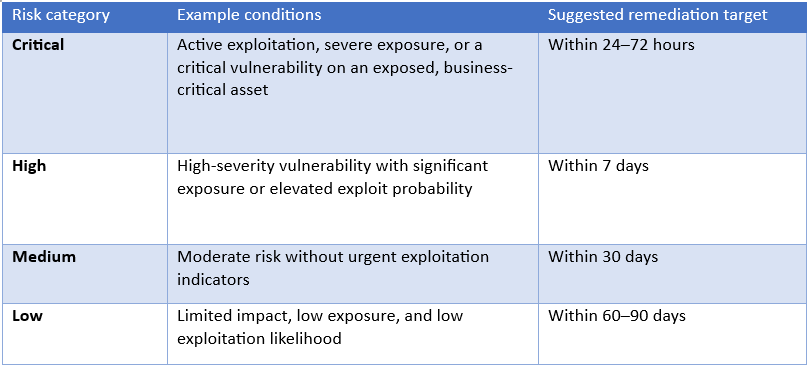
These targets should be calibrated to the organization's environment. A regulated organization or one operating highly sensitive infrastructure may need stricter deadlines.
Likewise, active exploitation, emergency vendor advisories, or binding regulatory requirements may demand action sooner than the standard SLA allows.
A severity-only table is useful, but it becomes more effective when combined with escalation rules.
For example:
These rules help teams respond to changing threats without rewriting the entire SLA policy every time a new vulnerability emerges.
An effective SLA begins with visibility.
Organizations need to know which vulnerabilities affect their infrastructure, applications, endpoints, cloud resources, and container images.
Automated vulnerability scanning can help identify affected assets and provide information about severity, affected software, and available remediation guidance.
However, scanning alone is not enough. Findings should be mapped to accurate asset ownership and business context.
Without this information, organizations may struggle to assign remediation tasks, evaluate business impact, or determine whether an SLA has been met.
Use a combination of technical severity and environmental context to determine remediation priority.
A practical prioritization model can consider:
Organizations can use a scoring model to support consistent decisions, but a simple weighted score should not override urgent signals such as active exploitation.
For example, an actively exploited vulnerability affecting an internet-facing production server should trigger emergency handling even if an aggregate score places it below another finding.
Ambiguous SLA definitions create confusion and make reporting unreliable.
Organizations should explicitly define when the remediation clock starts. Possible starting points include:
A practical approach is to start the SLA when a vulnerability is identified and validated, with risk classification performed promptly. Emergency threat signals should trigger escalation immediately rather than waiting for routine triage.
The organization should also define what constitutes successful remediation.
Installing a patch is not always sufficient. Teams should verify that the affected software is updated, the vulnerable configuration is corrected, or the exposure has otherwise been eliminated through an approved remediation measure.
A vulnerability should not be marked as remediated solely because a patch deployment job reported success.
Patching production systems without appropriate testing can introduce service disruptions, compatibility problems, or unexpected downtime.
A realistic remediation process should include:
For actively exploited vulnerabilities, emergency change procedures may be necessary to reduce exposure quickly.
The goal is to minimize both cybersecurity risk and operational risk. Testing and approvals should be proportionate to the urgency of the threat.
Every vulnerability should have an accountable owner.
Security teams are often responsible for identifying and prioritizing vulnerabilities, while infrastructure, application, endpoint, or cloud teams perform the remediation.
A clearly defined ownership model should specify who is responsible for:
When ownership is unclear, vulnerabilities can remain unresolved even when the required patch is readily available.
Some vulnerabilities cannot be remediated within the prescribed timeframe because of vendor limitations, application compatibility, operational dependencies, or the absence of a reliable fix.
Organizations should not handle these cases by informally extending deadlines.
Instead, an exception process should require:
Compensating controls might include restricting network access, disabling a vulnerable feature, isolating an affected system, or applying a vendor-recommended mitigation.
An exception should represent an explicitly accepted and monitored risk, not a permanent substitute for remediation.
Manual tracking becomes difficult when organizations manage thousands of vulnerability findings across multiple teams.
Automation can help security teams:
Automation is particularly useful for reducing repetitive administrative work and ensuring that high-risk findings do not disappear into large remediation backlogs.
A well-designed SLA program should measure both operational performance and actual risk reduction.
Important metrics include:
SLA compliance rate: The percentage of vulnerabilities remediated within their assigned deadlines.
Mean Time to Remediate (MTTR): The average time required to remediate vulnerabilities, segmented by risk category.
Overdue critical vulnerabilities: The number of critical findings that have exceeded their remediation deadlines.
Known exploited vulnerability backlog: The number of unresolved vulnerabilities associated with documented exploitation in the wild.
Vulnerability age: How long vulnerabilities have remained open, particularly high-risk findings.
Exception rate: The proportion of vulnerabilities requiring formal SLA exceptions.
Patch deployment success rate: The percentage of patch deployments completed successfully without requiring rollback.
Remediation verification rate: The percentage of closed findings that have been validated through rescanning, configuration checks, or other appropriate evidence.
These metrics provide a more complete view of security effectiveness than SLA compliance alone.
For example, an improving compliance rate combined with a declining known-exploited backlog suggests that remediation efforts are addressing important risks. Conversely, repeated extensions and a growing critical backlog may indicate that deadlines, staffing, or operational processes need attention.
Meeting remediation SLAs requires more than identifying vulnerabilities. Organizations also need effective prioritization, remediation workflows, and patch deployment capabilities.
SecOps Solution offers vulnerability and patch management capabilities designed to help organizations improve security visibility and streamline remediation.
Key features include:
By connecting vulnerability identification and risk prioritization with patch management, SecOps Solution helps organizations work toward more efficient remediation and better control over unresolved vulnerabilities.
Vulnerability remediation SLAs are most effective when they reflect the real risks facing an organization.
Fixed deadlines based only on severity scores can overlook actively exploited vulnerabilities, exposed business-critical systems, and other threats that require immediate attention. A risk-based model provides a more practical alternative by combining CVSS, EPSS, known exploitation, asset criticality, and operational context.
To build an effective SLA program, organizations should maintain accurate asset inventories, establish clear deadlines, assign accountable owners, automate tracking, and implement formal exception management. They should also measure actual risk reduction rather than relying exclusively on compliance percentages.
Most importantly, remediation SLAs should evolve as the threat landscape and business environment change.
The ultimate goal is simple: fix the vulnerabilities that matter most, within the timeframes that meaningfully reduce risk, without creating unnecessary operational disruption.
With a well-defined risk-based remediation strategy and the right vulnerability and patch management processes, organizations can move beyond reactive patching toward a more proactive and measurable security program.
SecOps Solution is an agentless patch and vulnerability management platform that helps organizations quickly remediate security risks across operating systems and third-party applications, both on-prem and remote.
Contact us to learn more.


.jpg)